
The freezer in your GE Monogram built-in still feels cold, but the fridge side keeps getting warmer and the milk isn’t lasting. Very often the cause is a small part that most owners never see: the evaporator fan. Our technicians recently repaired a GE Monogram built-in side-by-side that was not cooling for exactly this reason. Here is what the evaporator fan does, how to tell if it failed, and what you can safely check before you call.
Safety first: switch the refrigerator off at its breaker or unplug it before you remove any panel or clean the condenser. Never chip ice away with a knife or screwdriver: you can puncture a cooling line.
What the evaporator fan does
The cold in your refrigerator is made in one place: the evaporator coil behind the back panel of the freezer. The evaporator fan blows air across that coil and pushes the cold air through the freezer and into the fresh-food side. When the fan stops, the coil is still cold, but the cold stays behind the panel.
Signs the evaporator fan has failed
- The fridge side is warm, while the freezer is cold only near the back wall.
- You no longer hear the soft whir of the fan when you press the freezer door switch with the door open.
- You hear squealing, chirping or rattling from behind the freezer panel.
- Ice cream is soft and the ice maker is slow, even though the compressor is running.
1. Check the simple things first
Make sure the temperature settings have not been changed and that the doors close all the way. Look at the air vents inside the freezer and the fridge. Food packed tightly against them blocks the airflow and causes the same symptoms as a failed fan.
2. Look for frost on the back wall of the freezer
A thick layer of frost or ice on the back panel means the defrost system is not clearing the coil. Ice can then reach the fan blade and stop it. In that case the fan may be fine, and the defrost heater, sensor or control needs to be tested.
Need your appliance fixed?
Talk to a local technician or pick a time online. Service calls from $65, waived if you go ahead with the repair.
3. Listen for the fan
Open the freezer door and press the door switch by hand. Within a few seconds you should hear the fan and feel air moving from the vents. If the compressor is running but there is no fan sound at all, the fan motor has likely failed.
4. Clean the condenser
On built-in refrigerators the condenser sits on top, behind the grille, and collects dust quickly. A clogged condenser makes the whole refrigerator run warmer. With the power off, open the grille and gently vacuum the coils with a soft brush attachment. Do this once or twice a year.
What the repair involves
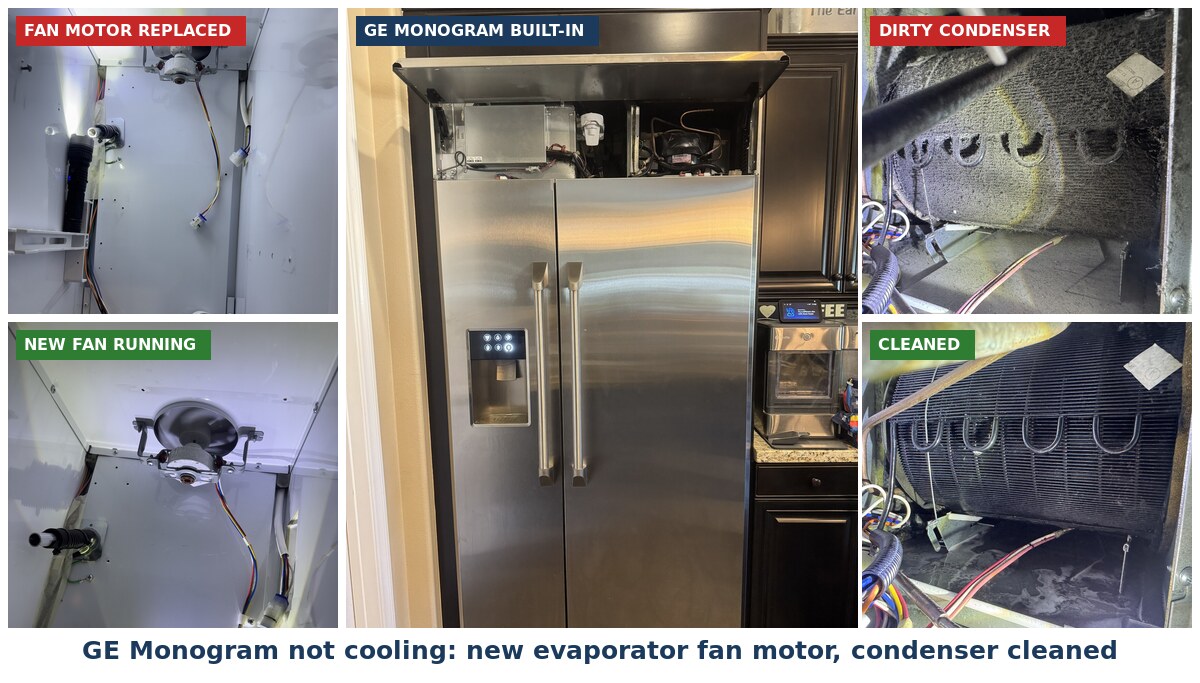
On the GE Monogram we repaired, the evaporator fan motor had failed, so cold air was not moving through the fridge. Our technicians removed the freezer shelves and the back panel, tested the motor and its power supply, and replaced the fan motor. We also cleaned the condenser coils on top of the unit, which were packed with dust, and checked the temperatures until the refrigerator was cooling properly again.
This is a much smaller repair than a compressor or sealed-system job, and it is well worth doing on a built-in refrigerator.
When to call a pro
Call for service if:
- The fridge side is warm and you can’t hear the fan in the freezer.
- The back wall of the freezer is covered with frost or ice.
- The fan is noisy, or it starts and stops.
- The refrigerator is still warm after you cleaned the condenser and cleared the vents.
Built-in refrigerator repair in Corona
Call us if your built-in refrigerator is warm on the fridge side, the freezer fan is noisy or silent, frost is building up, or the unit runs without cooling. Our technicians repair all major brands, including built-in models like GE Monogram, Sub-Zero, Viking and KitchenAid.
Service calls start at $85, and the fee is waived when you go ahead with the repair. Same-day and next-day visits are available.
AV Appliance Repair · Licensed, insured & bonded · Lic. #A45173